CONFERENCE
About BA School of Business and Finance of the University of Latvia
The BA School of Business and Finance of the University of Latvia is the business school of the University of Latvia, specializing in business, finance, and management sciences. It offers modern, internationally recognized study programs that combine academic knowledge with practical skills.
The BA School of Business and Finance joined University of Latvia on September 1, 2025. Its integration into the University of Latvia is part of the national higher education reform aimed at strengthening research capacity and improving the quality of education. By combining its specialized expertise in finance education with the University of Latvia’s broad academic environment, a strong synergy is created, providing students with wider opportunities both in Latvia and internationally.
Within the Applied Sciences ecosystem of University of Latvia, The BA School of Business and Finance of the University of Latvia takes on the role of a specialized business school, developing excellence in competencies related to financial technologies, digital finance, cybersecurity management, and business process management. The BA School of Business and Finance of the University of Latvia operates as a center of science and innovation in the Baltic region, offers lifelong learning and professional development opportunities, and develops cooperation with employers and international partners.
Students gain both excellent knowledge and practical experience needed for a successful career in the global business environment.
Strategic focus
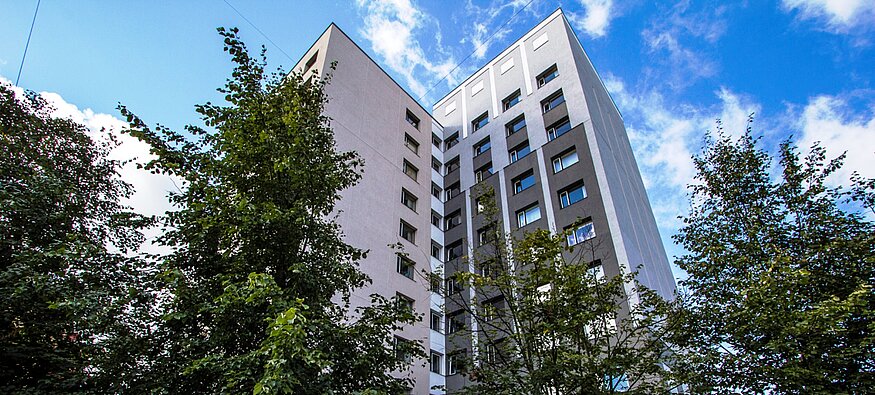
The strategic focus of BA School of Business and Finance of the University of Latvia until 2030 is to strengthen its status as an internationally recognized and highly regarded business school in the Baltic Sea region, specializing in financial technologies, business process management, and cybersecurity management, while fully operating within the ecosystem of the University of Latvia.
This includes a purposeful drive toward obtaining international business school accreditations, developing study programs in English and Executive education offerings, as well as ensuring sustainable performance in studies, research, and third-mission activities.
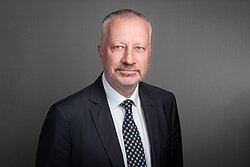
Dean

Inese Muzikante
Institutional development
Standing alongside six faculties of the University of Latvia, the business school must both align its core principles with the university’s overall developments and establish its own distinct positioning.
The academic staff of the business school should be strengthened with international lecturers and researchers in order to foster an internationally competitive study environment and promote integration into the global higher education space. To ensure competitiveness, an essential prerequisite is the improvement of study-related material and technical resources, as well as infrastructure appropriate for a contemporary and modern business school.
- Research funding attracted: EUR 276,884 (2025)
- State budget funding for studies: EUR 265,460 (2025)
- Revenue from tuition fees: EUR 2.01 million
- 23 academic positions, 3.65 FTEs
- 21 research positions, 7.48 FTEs
- Total area of real estate used to support the core functions of the business school: 4,257 m²
Executive Director

Andis Balodis
Development of studies
The aim of BA School of Business and Finance of the University of Latvia is to create an environment in which students acquire not only theoretical knowledge but also practical skills that meet the demands of a rapidly changing financial and business landscape.
Cooperation with industry enables the development of up-to-date, labour market–relevant competencies, while international partnerships expand opportunities for study and research, promote mobility, and strengthen the school’s international visibility and recognition.
- 903 students (as of 01.10.2025)
- 12 study programmes across short-cycle professional higher education, first-cycle (professional bachelor’s), second-cycle (professional master’s), and third-cycle (doctoral) levels
- 3 distance learning study programmes
- 7 study programmes delivered in English
- 766 undergraduate students (84% of students at BA School of Business and Finance of the University of Latvia)
- 114 postgraduate students (13%)
- 23 doctoral students (3%)
- 143 students in distance learning programmes (16%)
- 249 students in English-taught programmes (27%)
- 49 international students and exchange students (5%)
- 176 graduates (June 2025 data)
Acting Vice-Dean for Studies
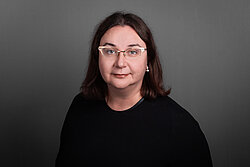
Tatjana Mavrenko
Scientific excellence
Integration into the ecosystem of the University of Latvia – a research university – creates an opportunity for BA School of Business and Finance of the University of Latvia to elevate research excellence to the next level.
The school commits to continuing its progress toward balancing research excellence and societal impact by purposefully promoting publications in internationally recognized academic journals, participation in European-level projects and consortia, and at the same time developing solutions that strengthen cooperation with industry partners in Latvia and the Baltic Sea region. This contributes meaningfully to societal resilience, human capital development, and overall well-being.
- 22 research positions (2025)
- Total FTE (including project-based research staff):
- 7 (2024)
- 13 (2025)
- Number of research projects:
- 11 (2024)
- 12 (2025)
- Research funding attracted: EUR 319,695 (2024)
- Private sector research funding: EUR 26,203 (2024)
- Average citation impact per publication in the Scopus database: 11.7 (2021–2024; recorded 29.11.2025)
- 79 out of 113 publications indexed and cited in Web of Science and Scopus databases (2021–2025)
- 9 monographs (2021–2025)
- 11 defended dissertations in the joint doctoral programme (2021–2025)
Contribution to society
As an academic institution of the University of Latvia, continuing the traditions of the BA School of Business and Finance, BA School of Business and Finance of the University of Latvia leverages its strengths to foster students’ interest in entrepreneurship and to align research and study programmes with societal needs, particularly in the development of financial literacy, sustainable entrepreneurship, digital competencies, and cybersecurity skills.
The school acts as a bridge between the creation of academic knowledge and practical solutions, helping society understand the impact of financial technologies, manage risks, leverage digital opportunities, and strengthen a culture of sustainable and responsible decision-making.
- Development of youth knowledge and competencies. Student participation in the “Bizness 24h” competition:
- 700 (2024)
- 687 (2025)
- Media visibility of management and academic staff (number of mentions):
- 40 (2024)
- 18 (2025)
- Synergy with the labour market. Employer representation at career days (number of stands):
- 23 (2024)
- 22 (2025)
- Synergy with the labour market. Employer guest lectures (number of events):
- 15 (2023/2024)
- 19 (2024/2025)
- Science communication activities (events explaining research and results):
- 5 (2024)
- 8 (2025)
- Contract research projects (commissioned by companies):
- 1 (2024)
- 2 (2025)
- Lifelong learning programmes implemented:
- 18 (2023)
- 8 (2024)
- Participants in lifelong learning programmes:
- 423 (2023–2024)
Acting Vice-Dean for Development